Agrellite (NaCa2Si4O10F) is a rare triclinic inosilicate mineral with four-periodic single chains of silica tetrahedra. The IMA symbol is Are.[3]
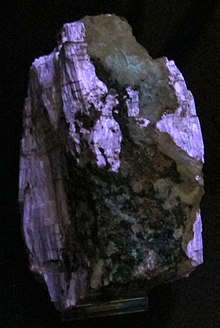
It is a white to grey translucent mineral, with a pearly luster and white streak. It has a mohs hardness of 5.5 and a specific gravity of 2.8. Its type locality is the Kipawa Alkaline Complex, Quebec, Canada, where it occurs as tabular laths in pegmatite lenses.[4] Other localities include Murmansk Oblast, Russia, Dara-i-Pioz Glacier, Tajikistan, and Saima Complex, Liaoning, China.[4] Common associates at the type locality include Zircon, Eudialyte, Vlasovite, Miserite, Mosandrite-(Ce), and Calcite.[4]
Agrellite displays pink fluorescence strongly under shortwave and weakly under longwave ultraviolet light.[5][6] The fluorescent activator is dominantly Mn2+, with minor Eu2+, Sm3+, and Dy3+.[6]
It is named in honor of Stuart Olof Agrell (1913–1996), a British mineralogist at Cambridge University.
| This article uses material from the Wikipedia article Metasyntactic variable, which is released under the Creative Commons Attribution-ShareAlike 3.0 Unported License |