Carpholite

Carpholite is a manganese silicate mineral with formula Mn2+Al2Si2O6(OH)4. It occurs as yellow clusters of slender prisms or needles. It crystallizes in the orthorhombic system.
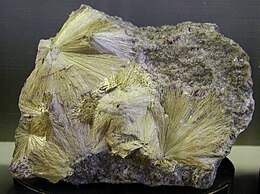
Carpholite
Carfolite.jpg
General
CategoryInosilicate
Formula
(repeating unit)
Mn2+Al2Si2O6(OH)4
Strunz classification9.DB.05
Crystal systemOrthorhombic
Crystal classDipyramidal (mmm)
H-M symbol: (2/m 2/m 2/m)
Space groupCcca
Unit cella = 13.83, b = 20.31,
c = 5.13 [Å]; Z = 8
Identification
ColorYellow
Crystal habitPrismatic, acicular to fibrous clusters
TwinningOn {100}
CleavagePerfect on {010}
TenacityBrittle
Mohs scale hardness5.5-6
LusterSilky
DiaphaneityTranslucent
Specific gravity2.935-3.031
Optical propertiesBiaxial (-)
Refractive indexnα = 1.610 nβ = 1.628
nγ = 1.630
Birefringenceδ = 0.020
PleochroismDistinct; X = Y = pale yellow;
Z = colorless
References[1][2][3]

The carpholite group includes ferrocarpholitemagnesiocarpholitevanadiocarpholite, and potassiccarpholite.

Discovery and occurrenceEdit

It was first described in 1817 for an occurrence in Horní Slavkov (Schlaggenwald), Karlovy Vary RegionBohemia. The name derives from Greek karfos for "straw" and lithos for "stone" due to its crystal habit.[3]

Its typical occurrence is in shales that have undergone low grade metamorphism. Associated minerals include sudoite, manganoan garnetchloritoid and fluorite.[1]

This article uses material from the Wikipedia article
 Metasyntactic variable, which is released under the 
Creative Commons
Attribution-ShareAlike 3.0 Unported License

Note

This article uses material from the Wikipedia article
 Metasyntactic variable, which is released under the 
Creative Commons
Attribution-ShareAlike 3.0 Unported License
.