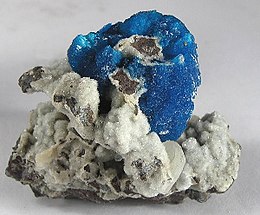
Cavansite, whose name is derived from its chemical composition, calcium vanadium silicate, is a deep blue hydrous calcium vanadium phyllosilicate mineral, occurring as a secondary mineral in basaltic and andesitic rocks along with a variety of zeolite minerals. Discovered in 1967 in Malheur County, Oregon, cavansite is a relatively rare mineral. It is polymorphic with the even rarer mineral, pentagonite. It is most frequently found in Pune, India and in the Deccan Traps, a large igneous province.
Uses of cavansite
While cavansite does contain vanadium, and could thus be a possible ore source for the element, it is not generally considered an ore mineral. However, because of its rich color and relative rarity, cavansite is a sought after collector's mineral.
Associated minerals

- Members of the apophyllite group
- Members of the zeolite group, particularly stilbite.
- babingtonite, Ca2Fe2Si5O14OH
- quartz, SiO2
- calcite, CaCO3
- pentagonite, Ca(VO)Si4O10 · 4(H2O)
Notes for identification

Cavansite is a distinctive mineral. It tends to form crystal aggregates, generally in the form of balls, up to a couple centimeters in size. Sometimes the balls are coarse enough to allow the individual crystals to be seen. Rarely, cavansite forms bowtie shaped aggregates. The color of cavansite is distinctive, almost always a rich, bright blue. The color is the same as its dimorph, pentagonite, but the latter is generally much more spikey with bladed crystals. Finally, the associated minerals are useful for identification, as cavansite is frequently found sitting atop a matrix of zeolites or apophyllites.
| This article uses material from the Wikipedia article Metasyntactic variable, which is released under the Creative Commons Attribution-ShareAlike 3.0 Unported License |