Macdonaldite

Macdonaldite is a rare barium silicate mineral with a chemical formula of BaCa4Si16O36(OH)2·10H2O.[6] Macdonaldite was first described in 1965 and named for Gordon A. Macdonald (1911–1978) an American volcanologist at the University of Hawaii.[6]
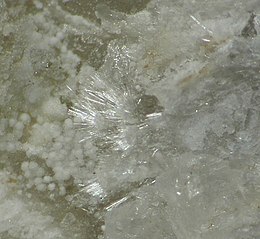
Macdonaldite
Macdonaldite-356329.jpg
White sprays of macdonaldite and blue botryoidal crust of mcguinnessite
General
CategoryPhyllosilicate
Formula
(repeating unit)
BaCa4Si16O36(OH)2·10H2O
Strunz classification9.EB.05
Crystal systemOrthorhombic
Crystal classDipyramidal (mmm)
H-M symbol: (2/m 2/m 2/m)
Space groupCmcm
Unit cella = 14.06 Å, b = 23.52 Å,
c = 13.08 Å; Z = 4
Identification
ColorColorless, white
Crystal habitAcicular also fibrous, in radiating aggregates; granular
Cleavage{010} perfect, {001} good, {100} indistinct
Mohs scale hardness3.5-4.0
LusterVitreous - silky
StreakWhite
DiaphaneityTransparent to translucent
Specific gravity2.27
Optical propertiesBiaxial (+/-), surface relief - low,
Refractive indexnα = 1.518 nβ = 1.524 nγ = 1.530
Birefringence0.012
2V angleMeasured: 90°
DispersionWeak
References[1][2][3][4][5]

Macdonaldite crystallises in the orthorhombic system. Macdonaldite is anisotropic with low relief.[7]

Macdonaldite appears as veins and fracture coatings in a sanbornite and quartz bearing metamorphic rock. Macdonaldite was first described in 1965 for an occurrence near the Big Creek-Rush Creek area in Fresno County, California. It has also been reported from Mariposa and Tulare counties in California.[3][6] It has also been reported from a quarry in San VenanzoUmbria, Italy.[3]

This article uses material from the Wikipedia article
 Metasyntactic variable, which is released under the 
Creative Commons
Attribution-ShareAlike 3.0 Unported License

Note

This article uses material from the Wikipedia article
 Metasyntactic variable, which is released under the 
Creative Commons
Attribution-ShareAlike 3.0 Unported License
.