Petalite, also known as castorite, is a lithium aluminium phyllosilicate mineral LiAlSi4O10, crystallizing in the monoclinic system. Petalite occurs as colorless, pink, grey, yellow, yellow grey, to white tabular crystals and columnar masses. It occurs in lithium-bearing pegmatites with spodumene, lepidolite, and tourmaline. Petalite is an important ore of lithium, and is converted to spodumene and quartz by heating to ~500 °C and under 3 kbar of pressure in the presence of a dense hydrous alkali borosilicate fluid with a minor carbonate component.[6] Petalite (and secondary spodumen formed from it) is lower in iron than primary spodumene, making it a more useful source of lithium in, e.g., the production of glass. The colorless varieties are often used as gemstones.[citation needed]

Discovery and occurrence
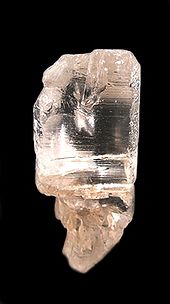
Petalite was discovered in 1800, by Brazilian naturalist and statesman Jose Bonifacio de Andrada e Silva. Type locality: Utö Island, Haninge, Stockholm, Sweden. The name is derived from the Greek word petalon, which means leaf, alluding to its perfect cleavage.[4][7][8]
Economic deposits of petalite are found near Kalgoorlie, Western Australia; Aracuai, Minas Gerais, Brazil; Karibib, Namibia; Manitoba, Canada; and Bikita, Zimbabwe.
The first important economic application for petalite was as a raw material for the glass-ceramic cooking ware CorningWare.[citation needed] It has been used as a raw material for ceramic glazes.
| This article uses material from the Wikipedia article Metasyntactic variable, which is released under the Creative Commons Attribution-ShareAlike 3.0 Unported License |