Spodumene is a pyroxene mineral consisting of lithium aluminium inosilicate, LiAl(SiO3)2, and is a source of lithium. It occurs as colorless to yellowish, purplish, or lilac kunzite (see below), yellowish-green or emerald-green hiddenite, prismatic crystals, often of great size. Single crystals of 14.3 m (47 ft) in size are reported from the Black Hills of South Dakota, United States.[5][6]
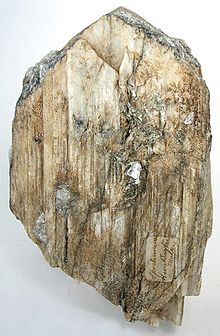
The naturally occurring low-temperature form α-spodumene is in the monoclinic system whereas the high-temperature β-spodumene crystallizes in the tetragonal system. α-spodumene converts to β-spodumene at temperatures above 900 °C.[4] Crystals are typically heavily striated parallel to the principal axis. Crystal faces are often etched and pitted with triangular markings.
Discovery and occurrence
Spodumene was first described in 1800 for an occurrence in the type locality in Utö, Södermanland, Sweden. It was discovered by Brazilian naturalist Jose Bonifacio de Andrada e Silva. The name is derived from the Greek spodumenos (σποδούμενος), meaning "burnt to ashes," owing to the opaque, ash-grey appearance of material refined for use in industry.[1]
Spodumene occurs in lithium-rich granite pegmatites and aplites. Associated minerals include: quartz, albite, petalite, eucryptite, lepidolite and beryl.[2]

Transparent material has long been used as a gemstone with varieties kunzite and hiddenite noted for their strong pleochroism. Source localities include Democratic Republic of Congo, Afghanistan, Australia, Brazil, Madagascar, Pakistan, Québec in Canada and North Carolina, California in the US.
Since 2018 the Democratic Republic of Congo is known to have the largest lithium spodumene hard rock deposit in the world.[7] The total resource of the deposit located in Manono, central DRC, has the potential to be in the magnitude of 1.5 billion tons of high-grade low-impurities lithium spodumene hard-rock. The two largest pegmatites (known as the Carriere de l'Este Pegmatite and the Roche Dure Pegmatite) are each of similar size or larger than the famous Greenbushes Pegmatite in Western Australia. In the near future by 2023, the Democratic Republic of Congo is expected to be a significant supplier of lithium to the world with its high grade and low impurities spodumene. In 2021, AVZ Minerals,[8] an Australian company, is developing the Manono Lithium and Tin project in Manono, DRC, the resource has high grade low impurities at 1.65% Li2O[9] (Lithium oxide) spodumene hard-rock based on studies and drilling of Roche Dure, one of several pegmatites in the deposit.
Economic importance
Spodumene is an important source of lithium for use in ceramics, mobile phone and automotive batteries, medicine, Pyroceram and as a fluxing agent. As of 2019, around half of lithium is extracted from mineral ores, which mainly consist of spodumene. Lithium is extracted from spodumene by fusing in acid after roasting to convert it to the more reactive β-spodumene. The advantage of spodumene as a lithium source compared to brine sources is the higher lithium concentration, at the expense of a higher extraction cost.[10]
In 2016, the price was forecast to be $500-600/ton for years to come.[11] However, price spiked above $800 in January 2018, and production increased more than consumption, reducing the price to $400 in September 2020.[12][13]
World production of lithium via spodumene was around 80,000 metric tonnes per annum in 2018, primarily from the Greenbushes pegmatite of Western Australia and from some Chinese and Chilean sources. The Talison mine in Greenbushes, Western Australia is reported to be the 2nd largest and to have the highest grade of ore at 2.4% Li2O (2012 figures).[14]
In 2020 Australia expanded spodumene mining to become the leading lithium producing country in the world[15] (see table below).[citation needed]
Advantages of spodumene compared to brine are:
- preferred in the manufacture of lithium hydroxide (a lithium compound used in the production of electric vehicle batteries)
- inception time for a plant: once an ore processing plant is complete, it can be producing lithium carbonate within days, whereas evaporation of brine to usable concentrations in open evaporation pans can take 18 months to 3 years, depending on evaporation rates and initial concentration.[citation needed]
Demand in lithium-ion batteries
Hard rock (spodumene) lithium concentrate offers a more direct refining route to lithium hydroxide production than brine processed lithium.[16] The growing trend for nickel-rich lithium-ion batteries[17] requires lithium hydroxide as the input in the chemistry of the battery cathode cells.[18] The nickel-rich batteries need lithium hydroxide for the battery cathode cells, namely NCM 811 cathodes, NCM 622, LFP and NCA. The demand for lithium hydroxide is expected to increase exponentially to 2025 through to 2030 along with it demand for spodumene hard rock lithium.[18] In a February 2021 report, Canalys, a research company, have forecasted by 2028 the global production of new electric vehicles (EVs) is expected to be more than 30 million vehicles annually.[19] 3.1 million EVs were sold globally in 2020.
The vehicle manufacturer Tesla is building a lithium conversion/refining facility in Austin, Texas that will turn spodumene hard rock 6% also known as spodumene concentrate 6% (SC6) into lithium hydroxide to be used in battery cells, allowing Tesla to better control the quality of the lithium hydroxide (a key battery cathode raw material).[20] Tesla signed a 5 year supply deal for lithium spodumene hard rock directly from a lithium mining operation—Piedmont Lithium—in North Carolina.[21]
This trend will likely be repeated[according to whom?] by other major auto manufacturers to secure more control over the upstream supply of lithium spodumene concentrate raw material by going directly to the miners, as lithium supply is forecast to be in deficit[clarification needed] by 2023[22] according to forecast analysis by Benchmark Mineral Intelligence (BMI),[23] London's price reporting agency and expert analysis on Lithium-ion battery and EV/electric storage industry. This deal represents about one-third of the expected 160,000 tonnes per annum production for Piedmont Lithium. 52,800 tons/yr of spodumene concentrate 6%, or SC6 ( equivalent to 8,000 tonnes of lithium hydroxide), this supply is to commence mid 2022/mid 2023, this amount is expected to satisfy over half of Tesla’s battery needs at Giga Texas in 2023, the year in which full production of the electric car maker’s 4680 cells for its Cybertrucks is planned.[24]
In December 2020 and early 2021, three significant long-term offtake agreements were executed with AVZ Minerals, an Australian company, for spodumene concentrate,[25] the deals are for the total of 540,000 tons/yr supply of (hard rock) lithium spodumene concentrate 6% (SC6), or 16% of global LCE lithium carbonate equivalent production (2020 global production of LCE was 431,000 tons). The three deals were made with the world's leading battery materials producers Ganfeng Lithium, Yibin Tianyi Lithium Co./Contemporary Amperex Technology (CATL) and Shenzhen.[citation needed]
Gemstone varieties
Hiddenite
Hiddenite is a pale, emerald-green gem variety first reported from Alexander County, North Carolina, US.[26] It was named in honor of William Earl Hidden (16 February 1853 - 12 June 1918), mining engineer, mineral collector, and mineral dealer.[27][additional citation(s) needed]
This emerald-green variety of spodumene is colored by chromium, just as for emeralds. Not all green spodumene is colored with chromium, which tend to have a lighter color, and therefore are not true hiddenite.[clarification needed]
Kunzite
Kunzite is a purple colored gemstone, a variety of spodumene with the color coming from minor to trace amounts of manganese. Some (but not all) kunzite used for gemstones has been heated to enhance its color. It is also frequently irradiated to enhance the color.[citation needed] Exposure to sunlight will fade its color.[27]
Kunzite was discovered in 1902, and was named after George Frederick Kunz, Tiffany & Co's chief jeweler at the time, and a noted mineralogist.[27] It has been found in Brazil, US, Canada, CIS, Mexico, Sweden, Western Australia, Afghanistan and Pakistan.[27][additional citation(s) needed]
One notable example of kunzite used in jewellery is in the Russian Palmette tiara and necklace worn by Birgitte,_Duchess_of_Gloucester.[citation needed]


Triphane
Triphane is the name used for yellowish varieties of spodumene.[28]
| This article uses material from the Wikipedia article Metasyntactic variable, which is released under the Creative Commons Attribution-ShareAlike 3.0 Unported License |